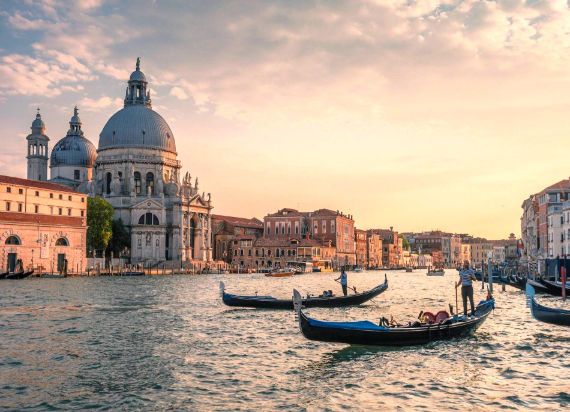
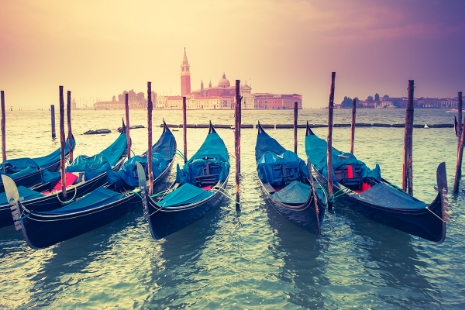
Venice Historical Regatta
also known as the Regata Storica
Dating back to the second half of the 13th Century, the Venice
Historical Regatta is a spectacular competition whose origins are firmly
entrenched in the history of Venice. As the maritime nation considered
it vital to have expert oarsmen.
The Venice historical regatta, is the main regatta of the year. Although
the other islands and communities of the Venetian lagoon also hold their
own regatta's throughout the calendar year. The Regata storica takes
place on the first Sunday of September in Venice, dates
of other regatta's can be found at the end of this document.
The historical regatta takes place on the Sunday afternoon. It begins
with a ceremonial parade along the Grand Canal of historical boats manned
by Venetians in period costume. The most important rowing races are
between the various neighborhoods of Venice.
Like the celebrated Palio of Sienna, the fans and followers of each
neighborhood boat and crew are a form of entertainment in themselves.
In fact, n ancient times, a fleet of bissone (typical long boats)
would proceed the race clearing the way and maintaining order.
The traditional points of reference for the Venice historical regata
are the spagheto, a rope stretched across the starting point
in front of the public gardens in the Castello sestiere of Venice; the
Paleto, a pole driven into the centre of the Grand Canal in front
of the Church of Sant'Andrea de la Zirada, around which the boats must
turn before going back up the Grand Canal to cross the finishing line.
The finishing line is indicated by the Machina, a construction
erected on a wooden raft richly carved, painted and gilded, and where
the prize-giving ceremony is held.
The historical regatta of Venice, re-enacted on an annual basis nowadays
also recalls the famous procession of the 16th Century when Caterina
Cornaro, a native Venetian who was later crowned Queen of Cyprus returned
to Venice to deliver the island of Cyprus into the hands of the Venetians.
Following this procession come the bisonni ( 8 oared Gondolas),
then, the balotine ( 6-oared Gondolas ), the decorative and ceremonial
gondolas of the various rowing clubs. Then, the competition starts with
a regatta for youngsters, followed by one for the women, and then finally
one for the two-oared gondolas that are numbered and colored differently.
Once the Regatta is finished, the canals of Venice come to life with
boats of various sizes, full of people celebrating amongst all the noise
and confusion. Other events, such as street-entertainers and other artists,
take place in he principal square's of Venice.
Other Regatta's
A regatta is made up of various races using different kinds of boats:
women and very young rowers race in their own categories. But,
the Regatta di Sant'Erasmo, the last of the season, is a mixed regatta
( one woman and one man racing together on the same boat ).
Regatta on the River of San Giobbe, Cannaregio, Venice, takes
place during carnival on February 21
Regata
Storica, 1st Sunday of Septmber
Regatta
di Caorle, mid-August
Regata
di Burano, 3rd Sunday of September
Regata
di Sant'Erasmo, late September-early October
Top