Tour of Renaissance Rome
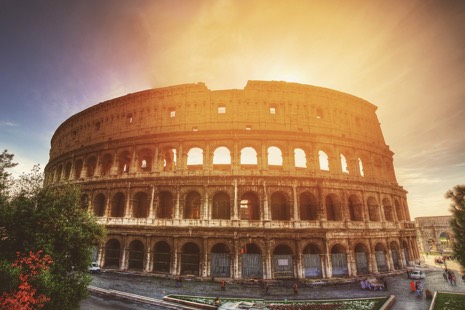
During the Middle Ages, the city of Rome was abandoned due to the transfer
of the papal court to Avignon, in France. The absence of the Pope caused
a severe economic crisis that forced the population to abandon the city.
Reduced to poverty, Rome became a mass of ruins where herds of sheep
and cattle grazed. But, after the year 1418, the year when Pope Martin
V re-established the Papal see in Rome, the city began to be born again.
And by the end of the 15th Century it was again a great capital.
Ordered by Pope Sixtus IV, from which it takes its name, the Sistine
Chapel is the most emblematic example of papal patronage during the
Renaissance. Initially, it was decorated with extraordinary frescoes
that still run along the walls of the chapel, boasting such famous artists
as Botticelli, Perugino and Ghirlandaio. But, its fame comes from the
frescoes added later to the ceiling by Michelangelo. No Renaissance
tour, or even a visit to Rome for the first time visitor would be complete
without viewing the most treasured work of art in the world. Enjoy a
full explanation and interpretation of this work on our Vatican
Tour.
Another great Renaissance artist lingers in the Vatican, no other than
Raphael, who decorated a series of rooms in the Vatican, while Michelangelo
painted the Sistine chapel. St. Peter's adjacent to the Vatican museum
is a fine example of Renaissance architecture, the dome by Michelangelo
and the sheer magnitude of church itself from the designs of Bramante,
executed by Michelangelo.
Further examples of the patronage of Pope Sixtus IV can be found at
the Church of Santa Maria della Pace. Inside are frescoes by Peruzzi
and Raphael. To plunge completely into the Renaissance atmosphere, it
is sufficient to lose yourself amongst the alleys of the Parione Quarter
where the facades of the buildings give great pleasure, often compounded
by the amazement over the unexpected discovery of a hidden courtyard.
Just off Via Guilia, one of the most important streets during Renaissance
times, you'll find the Piazza Farnese, laid out like a giant drawing
room is named after the Palazzo Farnese that dominates the square. Built
by Sangallo, Michelangelo did the central window, cornice and the third
floor of court. Via Giulia itself was opened by Pope Julius II following
a plan by Bramante, the close friend of Rafael and arguably one of the
most influential of Rome's architects. Many of his works greatly influenced
the young Palladio when he made his first visit to Rome.
The Villa Chigi, known as the La Farnesina, is an architectural masterpiece
by Baldassare Peruuzi. This suburban home built in the 16th Century
for the rich Sienese banker Agostino Chigi features frescoes by Peruzzi
and Raphael. Along with the art and architecture, the Renaissance was
also a time when the Romans started again to build lavish gardens (see
Roman Villas & Gardens).
Top